Ever get tired of trying to come up with the right thing to say in that frustrating interaction with your friend, spouse, co-worker, neighbor, or roommate? Wish someone else could figure out how to reply to that crazy email or phone message you received? Let the Relationship Ghostwriter take some of the pressure off by crafting your next response for you. (Click here to find out more about the Relationship Ghostwriter.)
Showing posts with label confidence. Show all posts

Summer Love?

The Relationship Ghostwriter loves to get some sun in
the summertime.  It likes to have that off-white glow.
THE ASSIGNMENT
“I was going out with a guy, who I’ll call Dan, during the last three months or so. We are students at the same university. Things were getting pretty serious. We were seeing each other just about every day and we had a fun, relaxed vibe together. We acted like a couple, but we didn’t talk about being in a relationship. Now that school is out, we’ve both gone home to different states for the summer.

I didn’t talk to Dan about staying in touch.  I just assumed we would. The trouble is, Dan hasn’t called, emailed, texted… nothing! I haven’t heard from him at all for a month! I know he’s fine because he’s been on facebook. I don’t know if this is just normal for him or if he’s trying to distance himself from me. I don’t want the relationship to end, and I don’t want to wait for next semester to get back in touch. What should I do? I am not high maintenance and I don’t want to come off as desperate. But I’m not really into this ‘out of sight, out of mind’ thing either.”

—Cara


THE GHOSTWRITER’S RESPONSE

THE SETUP: What if Dan were your brother, cousin, or a good friend from high school?  In other words, let’s say Dan is someone you have a warm, close relationship with but don’t necessarily talk to all the time.  How would you get back in touch after a month?  You wouldn’t spend a lot of time wondering if he wanted to hear from you or not, or worrying you might seem high-maintenance.  You would share an inside joke, share a funny story, briefly say how you’ve been, and ask how he’s been.  You would assume he thought fondly of you.  Try to get into that frame of mind and send a simple friendly email. 

YOU WRITE: Jump right in with a funny story or inside joke, like this: “Guess what happened yesterday?!  I saw a woman wearing a cape!”  (Or whatever.  Share a story however you normally would with Dan.)  Next, something quick about how you’re doing—for instance, “I’m loving being a lifeguard.  You wouldn’t believe what I get paid to sit there in the sun and announce adult swims!”  (Obviously, personalize this for you… or Dan will have you institutionalized.)  Finally, ask how he is.  For example, “So how are you?  How’s the internship?”  Keep the tone natural, the email brief, and, most important, don’t try to send any pressuring messages between the lines.

WHAT NEXT: Dan may write back and stay in touch as you’d hoped.  He may write back and then fall out of touch again.  He may not write back at all.  Unfortunately, when any relationship is in its early stages—before you feel completely free to share any and all worries or frustrations—it’s really hard to know what to do about even simple differences in your personalities.  Having a clear sense of your personal priorities will serve you well right now—as will having confidence in yourself and patience.


THE STRATEGY
Sending a brief, friendly email using whatever tone is most fun and natural for you is a good way to open the door for Dan to get back in touch.  Some people are very low-key about staying in touch when they’re away, regardless of how they feel.  Of course there’s a chance that Dan doesn’t want a serious relationship, or, worst case, that he is trying to distance himself from you.  On the other hand, here’s a best-case scenario: Dan is just caught up in being back home and feels so comfortable and happy with you that he hasn’t worried about being out of touch.  Your friendly email provides Dan an easy and appealing way to reestablish contact, and it provides you a chance to learn more about Dan.

Click to enlarge!
What if Dan is out of touch all summer?  What if he remains hard to read?  This is where your personal priorities become so important.  Take the Ownership Challenge to sort out what, if anything, you want to do about this now.  Think carefully about what is most important to you.  If it feels most important to be in a romantic relationship this summer, perhaps Dan isn’t the best candidate.  If it is your priority to see where things go with Dan, fostering healthy self-confidence will help give you patience as you wait to find out what he has in mind.  There are many other choices for each priority, and many other possible priorities.  Take your time.  There’s no wrong answer—what matters is owning your options.

Here’s a great general priority to keep in mind when beginning any relationship: be your favorite version of yourself.  All of us do at least a little shape-shifting as we interact with different people—a grandparent brings out certain facets of our personality, while a rude boss brings out others.  When does your own personal favorite version of yourself come out?  How would that person respond to Dan in this and other situations?  If Dan is the right guy, the two of you will get along best when you are yourself—that is, when you act in ways that let you feel like your favorite, most content, most happy version of yourself.

Savor the Favor

THE ASSIGNMENT
"I am a senior at ucla and I plan to go to law school so I need to write up lots of applications! the problem is I have to ask professors to write letters of recommendation for me!! I asked my TA and he said he'd do one because I was a good student, but he also said TA letters aren't as good as professor letters. he said just go see professors but when I think about that I get really scared. I took a senior seminar with a really good professor and I think she liked me a lot but how do you ask them something like that??

i just keep imagining that the professor wants to say no but she can't. it seems like it causes them so much trouble and if they don't really want to write it they have to figure out how to tell you. so how do you ask a professor to write a letter for you when you aren't sure if that's going to cause them trouble? I really want the letter so I can use it in my applications but I also want the professor to not feel bad like I'm bothering her?”

— Jackie


The Relationship Ghostwriter proudly wears its
cape when an event calls for professional attire.
THE GHOSTWRITER’S RESPONSE

THE SETUP:  You will give yourself the best chances of success by visiting the professor in person, and possibly sending a follow-up email later to thank her.  Dress in a reasonably professional manner—nothing too formal, but not gym clothes or pajamas—and go to the professor’s office hours.  If you are nervous, have a friend pretend she is the professor and practice with her in advance.  Make it your goal to use an assertive tone of voice.

When you arrive, greet your professor, and remind her of your name and what class you had with her.  Ask her if she is teaching the same class this semester, and how that is going.  Making some small talk in this way will get you used to hearing your voice in her office—it may seem inconsequential, but it is important to adjust to hearing yourself in any new context.  After the small talk dies its natural death, be sure to get right to the point:

YOU SAY:  I’m here to ask you for a letter of recommendation.  I’m applying to law schools.  I’m trying to get in to [insert names of law schools here].

WHAT NEXT:  Your professor is used to being asked for letters of recommendation.  She will likely have questions for you, such as, “How did you choose where to apply?”  In the day or so before you visit your professor, practice answers to possible questions during quiet moments—while you are getting ready in the morning, while walking to the library, etc.  Don’t script and memorize answers, just interview yourself and envision how you want to be perceived.  Plan to be specific.  Do not simply say “I don’t know” to any questions, and do not act as though you simply need a professor—any professor—to write a letter for you.  Why are you going to law school?  What made her a “good” professor?  Expressing clear reasons behind your choices will increase your chances of success.  From there, the ball will be in your professor’s court and the conversation will come to a natural conclusion.
 

THE STRATEGY
Being assertive and specific makes you sound and feel more confident, which in turns makes you appear more competent.  If you’re really struggling over how to sound assertive, visualize someone you know who is very successful in his or her work—perhaps even this professor.  How does that person sound when s/he is asked a question?  Get a sense of how it feels to act like that person.  Of course you won’t want to mirror someone else’s personality for the rest of all time, but you can learn you are capable of more than you think just by imitating someone you admire.

What about your concerns as to whether or not you should ask for a letter from this professor in the first place?  There are two things to consider.

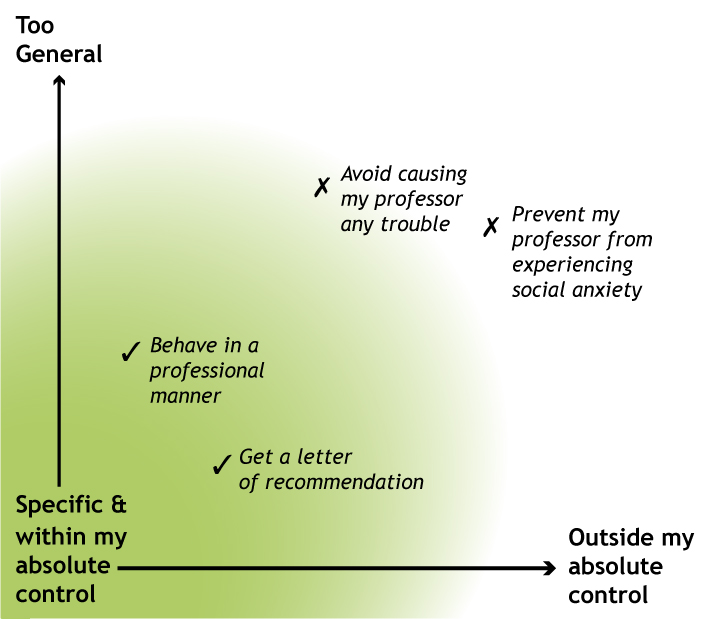
First, consider what the Ownership Challenge tells you to do.  You have identified a high priority: getting this letter of recommendation.  You also have another priority: to avoid troubling your professor; specifically, to prevent her from experiencing social anxiety over how to say “no” to you if she doesn’t want to write the letter.  This second priority is a slippery one, because it dances on the border of the Too-General-And-Too-Uncontrollable-So-Try-Again zone (the white part in the diagram below—as opposed to the green Winner’s Magical Zone of Specific Controllable-ness).


You are not in charge of how your professor feels.  You can influence her reaction (for example, by acting professional no matter what), but it is her Ownership Challenge to take personal responsibility for her own decisions, satisfaction, and happiness.  Her reactions do not fall within your jurisdiction.  She has chosen a job in which she must find acceptable ways to say yes or no to exactly this kind of request—whether or not you ask her, she will be asked by future students, and her contentment is her concern.
  
One of the best ways to avoid overstepping your jurisdiction in the Ownership Challenge is to imagine that everyone around you is also engaged in the Ownership Challenge.  This is not always true, of course, but the belief leads to healthy results.  When you believe others are also taking ownership, you are freed of wasting energy on worries over which you have very limited control.  For example, let’s say you ask your roommate to join you for dinner.  You ask if she wants Chinese or Mexican food.  She says she wants Mexican.  You either believe her (good), or you fret over whether she has unspoken preferences and will be unhappy (not so good).  Perhaps she is keeping something from you—perhaps she even has a habit of passive-aggressively consenting to choices that don’t suit her, then playing the martyr.  Even if this is true, her un-assertive behavior is not an effective long-term strategy, and she will have trouble finding satisfaction in life whether you cater to her or not.  If you simply believe what she tells you and then act on it with positive intentions, you are modeling more strategic and effective behavior for her, and you are saving yourself a lot of guesswork.

Finally, the second and last consideration: a simple reframing of the situation.  You are understandably anxious about making this request of your professor.  That is normal.  By extension, it is natural to imagine that your professor feels burdened by the job of writing the letter.  Reframe this.  You are giving your professor an opportunity to provide a service at which she excels.  She benefits from helping you: you validate her career, her worth, and her human generosity.  Our culture tends to assume that asking help of others is an imposition.  But, when we ourselves help others, we feel bighearted.  We feel valued.  We feel good about ourselves.

Believe that your professor is equipped to handle your request and to assert herself.  And, if she says she wants to write the letter, believe her, thank her sincerely, and move forward.