Ever get tired of trying to come up with the right thing to say in that frustrating interaction with your friend, spouse, co-worker, neighbor, or roommate? Wish someone else could figure out how to reply to that crazy email or phone message you received? Let the Relationship Ghostwriter take some of the pressure off by crafting your next response for you. (Click here to find out more about the Relationship Ghostwriter.)
Showing posts with label assertive. Show all posts

Three’s a Crowd


THE ASSIGNMENT
It’s tiresome to have a third party meddling in your romance. The
Relationship Ghostwriter still feels incensed upon recalling the
indignity dear Peggy Eaton suffered at the hands of Mrs. John C.
Calhoun during that blasted Petticoat Affair!
“My boyfriend of one and a half months (‘Mark’) lives with his friend and his friend's girlfriend (‘Jill’). Mark is very close with Jill - they talk about her relationship issues, they share a lot of inside jokes and tease each other constantly, and he used to visit her in her hometown before she moved in with them. After spending time around them, I end up feeling like I'm playing second fiddle to his lady-roommate, when I should really be his priority, no?

For example, I'll ask Mark to come out for drinks with me, and he'll decline because he has to study, so I leave him alone. But when Jill asks and he declines, she'll push until he gives in. Mark has a passive personality, and he’s admitted that he has a hard time saying no. Plus, Jill loves the attention Mark gives her, and I'm sure Mark loves a tall, curvy blonde giving him attention.

So far, I haven't been able to articulate my feelings on the issue to Mark. Usually, if we’re all hanging out and I witness some interaction, I’ll sulk. Definitely not the best way to handle the situation. Mark will typically notice and ask if something is wrong, but I deny that there’s a problem. Since we haven't been together very long, I'm worried that I'll come across as insecure and jealous, or that I’ll put him in an awkward situation - trying to please both Jill and me - and that's not altogether fair. I'm also worried making Jill an issue gives her what she wants - to be the center of attention and the reason that my boyfriend and I are at odds.  Maybe Mark will even defend her!

I would love for Mark to stand up to Jill, if that's the issue. Or to be as receptive to my demands as he is to hers, without me having to turn into a nagging girlfriend! And, of course, I would love for this girl to lay off Mark a little and realize that I'm supposed to be the main girl in his life. I know they're friends, and I'm fine that they're close for the most part, but she has a boyfriend! I want her to leave my boyfriend alone!”

—Jennifer


THE GHOSTWRITER’S RESPONSE

Here’s one of many direct but still respectful ways to delve into the topic of Jill with Mark.

YOU SAY: (in a comfortable tone, alone with Mark) “Jill is really fond of you, and of course it’s easy for me to see why.  You know, sometimes I wonder if you two would be in a relationship if it weren’t for her boyfriend.  I know that’s an awkward thing for me to say, but it’s occurred to me before.  Is it cool for me to ask you about that?”


THE STRATEGY
Your challenge is to find a satisfying balance between social grace (putting your best foot forward) and honesty (speaking up for what you need).  Sometimes you can do both simultaneously.  Making yourself appealing to others gets you many of the things you need.  Being assertive makes you appealing.  But sometimes you must risk making a move another person may dislike to get something you need.  If you veer too far into being appealing at the cost of being assertive, your needs will go unnoticed or unmet.

The example above shows one of many ways you could tackle the “Jill” problem honestly (being direct, assertive) and gracefully (being respectful, reasonable)—a move that will usually strengthen, not damage, a healthy relationship.  But being direct about something you want or need isn’t easy.  It feels very risky socially, especially at the beginning of a relationship.  Is it worth doing?  You feel unsatisfied, so at least it’s worth a closer look.

It’s clear that Jill is acting in bad form.  And you aren’t sure about Mark’s intentions.  What can you do?  Shift the focus to your choices, away from Jill’s or Mark’s.  Ask yourself, “Are my actions supporting my priorities?”  To get a clear picture of your priorities, first brainstorm a list of all the things you would like to see come of this situation.  Maybe it starts something like this (in no particular order):


Next—and this is really important—edit this into a list of personal goals instead of a simple wish list.  Do this by deleting or reframing items until the list contains only that which is specific and within your control.  In other words, each item must theoretically be achievable by you alone in the near future.  Here’s a start:


Now you have a sharper focus on what matters most to you.  When you’re unsure about your goals, you cannot commit to a strategy and you usually feel dissatisfied.  For instance, you described how sulking was unsatisfying.  That’s because you were in limbo, committed neither to being assertive nor being stoic.  When you have clarity about your priorities, it’s easier to commit and to make deliberate concessions when necessary to accomplish what matters most.

You may come out feeling motivated to try something new, even if that something is challenging or risky.  If you prioritize the “happy, healthy, committed relationship” standard above all else, it may motivate you to be gracefully honest with Mark about how his intimacy with Jill makes you feel.  If the relationship is up to your standards, he will be on your team and will try to make things better even if you disagree and it is challenging.  If he’s not on your team, that hurts, but it’s good to know because you are unwilling to settle for a relationship that doesn’t work for both of you.

Priorities and motivations are deeply personal, so they will be different for everyone.  What matters more than what you choose is simply that you own the decision-making process.*  Own the fact that one goal is more important to you than another.  Own the concessions you are willing to make to achieve that goal.  Deep dissatisfaction comes from feeling powerless in the face of other people’s choices.  Satisfaction and contentment come from empowering yourself by committing to specific, achievable personal goals based on your priorities.


-----------------------------------------------------------------------------------------------------------


* Note to readers: The Relationship Ghostwriter is not saying it is okay to go murder someone as long as you own the decision-making process.  If that’s what you were thinking, stop being snarky and go talk to a spiritual advisor about Right and Wrong instead of chillin’ (yes, like a villain) here.

Hierarchy Malarkey

Fig. 1) What not to do:
Passive behavior means bypassing your own wants and
needs to accommodate others. So, if the crocodile asks
for half your pie, you quickly hand over the whole pie.
THE ASSIGNMENT
“I have been working at a large organization for the past five years, and recently a new manager was put in charge of my unit with few technical skills and largely for political reasons. This person is not in the least qualified for the position, and, in addition, he constantly tries to put me down so he can appear more qualified. It seems to me that he is most interested in 'winning' a discussion and demonstrating his power over me. I work in a highly respected organization in which meritocracy is the standard, but where political appointments of this nature can occur.

I would like to be able to stand up to my new boss when he is technically wrong on issues, but not to the point that I put my own job at risk. In the past I tend to find ways to accommodate those who criticize or take advantage of me. I have not been very assertive, but would certainly like to become more so. I want to be honest and hold my ground. I have been told in the past that I am ‘too nice’ to get ahead. Only rarely do I insist on an argument to the point that my boss would be willing to change his mind. 

How does one treat an incompetent boss respectfully without condoning his incompetence?”

—Mr. Nice


Fig. 2) What not to do:
Passive-aggressive behavior means acting simultaneously
compliant and displeased. So, if the crocodile asks for
half your pie, you comply by giving him half, but you
roll your eyes while you do it.
THE GHOSTWRITER’S RESPONSE

THE SETUP: Here’s what you do to lay the groundwork to be well received when you respectfully assert yourself at work: 1) maintain a clear, strong sense of your personal principles and boundaries, and 2) cultivate affable relationships with your colleagues.  Putting a little energy into these two strategies every day sets you up to be more comfortable and persuasive when asserting your wants and needs.  For example, let’s say your boss makes a declaration that doesn’t work for you during a meeting, and you want to assert yourself:

HE SAYS: “Okay, so we can all agree that the sky is green, yes?  As of today, we are going to launch a new campaign centered on this fact.”

YOU SAY: (in a collaborative, unanxious tone) “Can we pause for a moment?  I have serious concerns about saying the sky is green.  I actually have an entirely different view.  I believe the sky is blue, and I’m going to have a hard time reconciling both ideas.”

WHAT NEXT: The affable relationships you have cultivated paired with the way you consistently keep to your principles will increase the probability that the group will value what you have to say and begin a constructive conversation about the issue at hand.  If, in spite of everything, your dysfunctional boss stays true to form and only wants to argue with you, you are not obliged to play that win/lose game with him.  Use active listening to let him feel heard without having to agree or disagree.  Keep the Ownership Challenge in mind as you decide how far you are willing to go to try to persuade him to change.


Fig. 3) What not to do:
Aggressive behavior means overcompensating for
your wants and needs. So, if the crocodile asks for half
your pie, you—outraged that he wants more than just
a slice—throw the whole pie in his face.
THE STRATEGY
Being under the authority of someone you believe to be incompetent or dysfunctional is extraordinarily frustrating.  There’s no perfect solution, but assertiveness certainly helps.  Being assertive does not mean being unaccommodating, disrespectful, or insubordinate; on the contrary, in a functional work environment, assertiveness is the most respectful and effective communication style.  (For more on communication styles, click here.)

Why are boundaries and affability such important foundations for assertiveness?  Imagine the ideal competent co-worker.  This person works hard.  He also takes the time to know you personally.  He doesn’t just say, “How are you?” in a friendly way—he remembers a few specific things, like, “How did the barbecue go?”  Imagine that this guy is also very consistent—you can rely on him to produce great work, and you can expect to hit a brick wall if you attempt to manipulate or bully him.  You like this person because you don’t have to worry about him—he is a solid team member, he is personable, and he will look after his own wants and needs.

Fig. 4) What TO do:
Assertive behavior means respectfully taking care
of your own wants and needs—nothing more, nothing
less. So, if the crocodile asks for half your pie, you tell
him you can’t give him that much, but you’ll be happy
to share a slice. You’re both winners!
Now imagine this person sitting in a meeting.  Here’s where all his work pays off: it is really hard to be a jerk to this guy.  Not only do you respect and like him—you aren’t able to take advantage of him.  Treating him with disrespect or wasting his time with an unreasonable argument would earn you the disapproval of the rest of the team.  And it’s not just because he’s nice—he’s likable and assertive.

None of us is so perfect and consistent all the time.  But keeping a model in mind, real or imagined, is a helpful strategy as you work on breaking old habits—you can check in with what your model might do if you feel stuck accommodating when you’d rather be asserting.  Unfortunately, being more assertive doesn’t guarantee your boss will ever change or improve—that is not fully within your control.  What you will gain instead is the assurance that your own wants and needs are a priority, leaving you more satisfied at the end of the day and better able to deal with your boss’s nonsense tomorrow.

Savor the Favor

THE ASSIGNMENT
"I am a senior at ucla and I plan to go to law school so I need to write up lots of applications! the problem is I have to ask professors to write letters of recommendation for me!! I asked my TA and he said he'd do one because I was a good student, but he also said TA letters aren't as good as professor letters. he said just go see professors but when I think about that I get really scared. I took a senior seminar with a really good professor and I think she liked me a lot but how do you ask them something like that??

i just keep imagining that the professor wants to say no but she can't. it seems like it causes them so much trouble and if they don't really want to write it they have to figure out how to tell you. so how do you ask a professor to write a letter for you when you aren't sure if that's going to cause them trouble? I really want the letter so I can use it in my applications but I also want the professor to not feel bad like I'm bothering her?”

— Jackie


The Relationship Ghostwriter proudly wears its
cape when an event calls for professional attire.
THE GHOSTWRITER’S RESPONSE

THE SETUP:  You will give yourself the best chances of success by visiting the professor in person, and possibly sending a follow-up email later to thank her.  Dress in a reasonably professional manner—nothing too formal, but not gym clothes or pajamas—and go to the professor’s office hours.  If you are nervous, have a friend pretend she is the professor and practice with her in advance.  Make it your goal to use an assertive tone of voice.

When you arrive, greet your professor, and remind her of your name and what class you had with her.  Ask her if she is teaching the same class this semester, and how that is going.  Making some small talk in this way will get you used to hearing your voice in her office—it may seem inconsequential, but it is important to adjust to hearing yourself in any new context.  After the small talk dies its natural death, be sure to get right to the point:

YOU SAY:  I’m here to ask you for a letter of recommendation.  I’m applying to law schools.  I’m trying to get in to [insert names of law schools here].

WHAT NEXT:  Your professor is used to being asked for letters of recommendation.  She will likely have questions for you, such as, “How did you choose where to apply?”  In the day or so before you visit your professor, practice answers to possible questions during quiet moments—while you are getting ready in the morning, while walking to the library, etc.  Don’t script and memorize answers, just interview yourself and envision how you want to be perceived.  Plan to be specific.  Do not simply say “I don’t know” to any questions, and do not act as though you simply need a professor—any professor—to write a letter for you.  Why are you going to law school?  What made her a “good” professor?  Expressing clear reasons behind your choices will increase your chances of success.  From there, the ball will be in your professor’s court and the conversation will come to a natural conclusion.
 

THE STRATEGY
Being assertive and specific makes you sound and feel more confident, which in turns makes you appear more competent.  If you’re really struggling over how to sound assertive, visualize someone you know who is very successful in his or her work—perhaps even this professor.  How does that person sound when s/he is asked a question?  Get a sense of how it feels to act like that person.  Of course you won’t want to mirror someone else’s personality for the rest of all time, but you can learn you are capable of more than you think just by imitating someone you admire.

What about your concerns as to whether or not you should ask for a letter from this professor in the first place?  There are two things to consider.

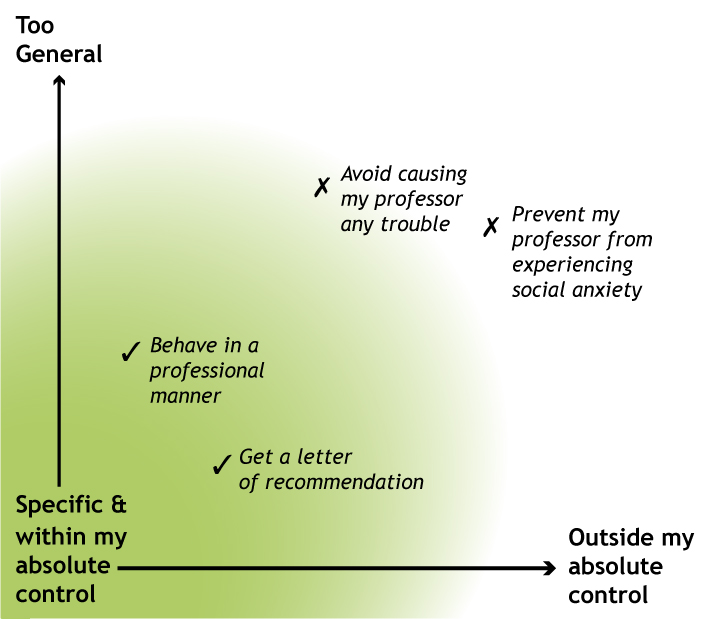
First, consider what the Ownership Challenge tells you to do.  You have identified a high priority: getting this letter of recommendation.  You also have another priority: to avoid troubling your professor; specifically, to prevent her from experiencing social anxiety over how to say “no” to you if she doesn’t want to write the letter.  This second priority is a slippery one, because it dances on the border of the Too-General-And-Too-Uncontrollable-So-Try-Again zone (the white part in the diagram below—as opposed to the green Winner’s Magical Zone of Specific Controllable-ness).


You are not in charge of how your professor feels.  You can influence her reaction (for example, by acting professional no matter what), but it is her Ownership Challenge to take personal responsibility for her own decisions, satisfaction, and happiness.  Her reactions do not fall within your jurisdiction.  She has chosen a job in which she must find acceptable ways to say yes or no to exactly this kind of request—whether or not you ask her, she will be asked by future students, and her contentment is her concern.
  
One of the best ways to avoid overstepping your jurisdiction in the Ownership Challenge is to imagine that everyone around you is also engaged in the Ownership Challenge.  This is not always true, of course, but the belief leads to healthy results.  When you believe others are also taking ownership, you are freed of wasting energy on worries over which you have very limited control.  For example, let’s say you ask your roommate to join you for dinner.  You ask if she wants Chinese or Mexican food.  She says she wants Mexican.  You either believe her (good), or you fret over whether she has unspoken preferences and will be unhappy (not so good).  Perhaps she is keeping something from you—perhaps she even has a habit of passive-aggressively consenting to choices that don’t suit her, then playing the martyr.  Even if this is true, her un-assertive behavior is not an effective long-term strategy, and she will have trouble finding satisfaction in life whether you cater to her or not.  If you simply believe what she tells you and then act on it with positive intentions, you are modeling more strategic and effective behavior for her, and you are saving yourself a lot of guesswork.

Finally, the second and last consideration: a simple reframing of the situation.  You are understandably anxious about making this request of your professor.  That is normal.  By extension, it is natural to imagine that your professor feels burdened by the job of writing the letter.  Reframe this.  You are giving your professor an opportunity to provide a service at which she excels.  She benefits from helping you: you validate her career, her worth, and her human generosity.  Our culture tends to assume that asking help of others is an imposition.  But, when we ourselves help others, we feel bighearted.  We feel valued.  We feel good about ourselves.

Believe that your professor is equipped to handle your request and to assert herself.  And, if she says she wants to write the letter, believe her, thank her sincerely, and move forward.

No Good Deed

THE ASSIGNMENT
The Relationship Ghostwriter has little use for driving.
Simply
manifesting in new locations is more efficient.
“My friend borrowed our car the other day to haul some cardboard to the dump. When he returned it, I discovered that the baby mirror in our backseat was broken in half. It is basically unusable now. It must have broken when he lowered the headrest and the seat to make room for his cardboard. I'm frustrated because he was not careful with our car and he ended up breaking a $20 item. Most importantly, I can't see my baby in her car seat now while I am driving. I don't understand how he could have missed hearing the plastic snap in half when it broke....or if he heard it, why didn't he say something to us?

I'm torn about whether or not to say something to him. On one hand, I want him to know he caused damage to the mirror and I want him to apologize for it. (The money is not an issue--I just want an apology.) On the other hand, I know if I say something, I will get one of two responses: 1) He will be defensive and say it must have already been broken, or 2) he will overcompensate and go out of his way to make amends. For example, I could easily see him buying another mirror (or two!) and then obsessively checking in with me every week to see how the new mirror is working and if everything is okay so that I end up thanking him for his good deed. So here's the question--do I say something to him or just let it be water off my back and forget about it? If I decide to say something, how should I phrase it? I don't want to lose a friendship over this, but I also don't want to let him borrow my car ever again!”

— Elaine


THE GHOSTWRITER’S RESPONSE

THE SETUP:  The Ownership Challenge will help you sort out what you want to do about this—whether or not it is your top priority to have a direct conversation with your friend.  If it is, find a time to talk with him, preferably in person, and use an assertive and respectful tone.  This meeting may feel tense or uncomfortable, which is normal, and it may be helpful to be open about that.

YOU SAY: “This is a little uncomfortable for me, and maybe for you too.  I believe I have an obligation to be honest and share a frustration with you.  When you returned the car a few days back, we noticed that our baby mirror in the back seat was broken.  I believe you must have broken it while you were using the car.  I know this was probably an accident.  You may not have even noticed it happened, or maybe you noticed but felt understandably embarrassed to say anything.  Do you remember what happened?”

WHAT’S NEXT: Let’s say your friend acknowledges fault and apologizes to your satisfaction.  Ideally he says, “Well, frankly, you’re right, I did hear a snap and saw it was broken, but I didn’t want to say anything.  I’m embarrassed and I’m really sorry.”  After any satisfactory response, you have an opportunity to ask questions.  For example, “Thanks for being so honest with me.  I accept your apology.  I’m curious to know a little more—how did it break?”  Ask any other clarifying questions you have, then lay out your specific needs: “Would you be willing to compensate us for the mirror this week?  Your apology means a lot to me, and if you would give us the $20, I’d be glad to consider everything over and done with, water under the bridge.”  Making a specific plan gives both of you a clear idea of what gestures will make things right—after those needs are fulfilled, it is over.

If your friend agrees and honors the plan, but he also continues to bring up what happened, or buys you two mirrors, you say warmly, “I appreciate that you’re trying to do so much to compensate for what happened, but please believe me that it is all over and done with now.  I want you to feel no obligation to ask about it any more —in fact, it makes me a little uncomfortable when you keep bringing it up because I am ready for it to be in the past.  You have done everything I needed, and I appreciate it.”  Repeat as needed.  Be warm and assertive.


Alternate Scenario:  What if you are not satisfied with your friend’s initial response?  Perhaps he flat out denies any wrongdoing, saying, “Wow, I don’t know what happened to your mirror, and I’m sorry if it got broken, but I don’t think it happened on my watch.”  Perhaps he sort of acknowledges responsibility but denies having known about it until now: “I have no idea what happened, but I’ll be glad to replace the mirror if that’s what you want.”  You said he might get defensive: “I can’t believe you think I would do that and not own up to it!”

There are no hard and fast rules about what is or isn’t satisfactory—it will be different for everyone and every situation.  Any response that feels unsatisfactory to you, though, does require you to make additional choices.  Think ownership.  You have gone down this path in the spirit of respectful honesty; let’s say you decide continue on this path.  You can use active listening and calmly reflect back whatever you hear: “This feels like a major accusation to you,” or “You were completely unaware that anything happened.”  Say these things like statements, not questions—let your voice go down at the end.  You are not trying to make any point.  You are simply letting your friend know you have heard him.

Be specific about your needs: “I understand that you weren’t aware it happened, and if you will replace the mirror, I’d be glad to forgive and forget.”  Or, if he continues to deny wrongdoing, “I’m disappointed because it seems very clear to me that you are responsible but you do not seem prepared to make things right.  What I need from you is an apology and for you to replace the mirror—then I will truly forgive and forget and we’ll go back to the way things have always been.”

If the conversation veers away from being civil and honest, put an end to it for now.  No matter the outcome, you honored your goal to respectfully express the problem and its impact.  If you feel a need for further resolution, many communities have mediation centers.  A mediator is an expert at facilitating exactly this type of dialogue and may offer new insights.


THE STRATEGY
You’re having a very normal and natural reaction after experiencing something that feels unfair or unjust.  The needs you describe are the same needs most of us have after someone has done us wrong—you need answers to questions, a meaningful apology, assurance it won’t happen again, and maybe financial compensation, among other things.  Accidents happen—your friend almost certainly did not intend to break the mirror—but it was bad form for him to fail to acknowledge what happened or offer an apology (presuming he knows it happened).

An aggravated Relationship Ghostwriter finds it much
more difficult to brainstorm constructive, satisfying
choices than does a calm Relationship Ghostwriter.
Having to take any action at all may be the thing that feels most unfair when another person’s wrongdoing affects you.  Think of a time when you’ve been in a traffic accident that wasn’t your fault—even though it was an accident, and the other person’s insurance will cover all financial losses, you still have a lot of unexpected trouble on your hands.  After any experience like this, make a point to let yourself grieve the external circumstances before you try to make any decisions about what to do next.

You didn’t ask to be dealing with this problem, and it’s natural to be angry or sad about having to face it at all.  If you are able to find healthy outlets for difficult emotions—allowing yourself to experience them, process them, and let them disperse—sooner or later you will feel ready and able to do what needs to be done: to stop grieving and to start reclaiming personal responsibility for the choices you do have and for your contentment.

Colleague Conundrum

THE ASSIGNMENT
“My coworker ‘Anna’ has a lot of strong opinions and she is really outspoken about them. Anna’s office is down the hall from mine and we’re friendly.  We email back and forth during the day.  Anna unloads all of her problems on me and she can be really harsh about her judgments and grudges with other coworkers.

I don’t usually share her opinions of other people because I’m more easy going, and I think she jumps to a lot of conclusions and is unfair about some of the things she says.  But I don’t want to disagree with her because then she might dislike me and I’ll be the target of gossip!

So I’m stuck because it’s like all I can do is agree with what she says in the emails.  If I don’t write back, she’ll come to my office to gossip, which I think is worse because we could be overheard much more easily and I don’t want people to think I share her opinions or attitude.

Here’s part of a typical email from her:

‘Pete told me he was mad I said shut up to him when we were joking around during the staff meeting. He was laughing when I said it! He is always whiny anyway so I dont care about him. but he needs to get over it and actually what is more rude is laughing one minute with someone and tricking me into thinking you are enjoying and then later coming saying its wrong of me to say shut up and acting all serious.  I will not talk more than business to Pete anymore I guess.’

I just want to fly low and I’m willing to email with her because I want to stay friendly, but I’m worried about just agreeing with everything she says all the time.  What should I write back that will satisfy her without having to agree with her?”

— Katie


THE GHOSTWRITER’S RESPONSE

YOU WRITE:  “That must have been awkward.  I can imagine you felt blindsided to find out he was angry after the fact.  It caught you off guard because you thought you were joking around with Pete and he saw it differently.  I like your idea to let things cool off for a while and just keep things respectfully professional with him for now.”

WHAT NEXT:  Anna may have more to say about what happened, and she may feel the impulse to prod you for your opinion, especially because that is something she is used to getting from you in the past.  If she asks “What do you think?” point-blank, you can be both honest and graceful in declining to choose a side, such as by saying, “I wasn’t there so I can’t be the judge.  But it sounds like your personalities clashed, and I know you didn’t intend to hurt his feelings so it annoyed you when he was upset.  What has it been like talking with him since then?”


THE STRATEGY
Katie has two priorities: 1) to avoid feeling cornered into siding with Anna, and 2) to avoid disagreeing with Anna.  Katie can satisfy both priorities using active listening.

Active listening enables Anna to feel heard and understood, and it enables Katie to provide a supportive response whether or not she agrees with what Anna says.  The Ghostwriter’s suggested response only relies on what Anna wrote.  It does not add anything new, such as Katie’s own opinion of Pete or of what Anna did.  The response summarizes the key pieces of Anna’s email, including the emotions Anna communicates between the lines.

Because Katie and Anna are friends, it is important that Katie maintain an appropriately intimate tone with her words.  This can be a challenge when you are first getting used to active listening techniques—you may come off as more distant or detached than usual when you start expressing empathy (“I can imagine how annoyed you felt toward Pete”) rather than sympathy (“I am annoyed at Pete on your behalf”).

That’s why it’s important that Katie to do more than simply summarize the key points of what Anna wrote.  Anna did not spell out her emotions, but Katie can use what she already knows of Anna, along with what is written between the lines, to reflect back what she believes Anna is feeling—“That must have been awkward,” or “You felt blindsided.”  Again, Katie is not required to judge whether these were suitable responses.

Another opportunity to express encouragement is to find those things you do agree with and call attention to them.  They don’t have to be big, obvious things—in this case, the Ghostwriter suggests taking what may actually be a defeatist statement of Anna’s (“I will not talk more than business to Pete anymore I guess”) and reframing it as a constructive action (“I like your idea to let things cool off…”).

Finally, if you are asked point-blank to choose a side, you can state your reluctance or inability to do so without catastrophic effects.  Be assertive, then follow it up with an empathetic reflection of what Anna experienced and an open-ended question.  What is most likely to be of value to Anna is Katie’s caring statement of understanding and her curiosity about what Anna is dealing with.  If Anna simply wants to hear someone agree with her unconditionally, she will need to look elsewhere.